BLAST #34 | British Art Fair Highlights Part 1
August 2026
For this and our next issue, we are turning the spotlight on our sponsors, British Art Fair, to see what is in store at the next fair at the end of September. Some of the content is already on the website, but here are a few highlights which have not yet been promoted, which we believe to be of significant interest. What becomes apparent is that exhibitors this year are creating more mini exhibitions within their stands, with a focus on individuals or groups that could add an educational element to what is fundamentally a commercial endeavour. An endeavour that, as always, balances the tried and tested (Hockney, Hepworth, Moore…) with the forgotten and undervalued (see Inshaw, Warburton, Bell below).
Harold Gilman (1876-1919), Snargate Rectory, 1910-1911. £38,000
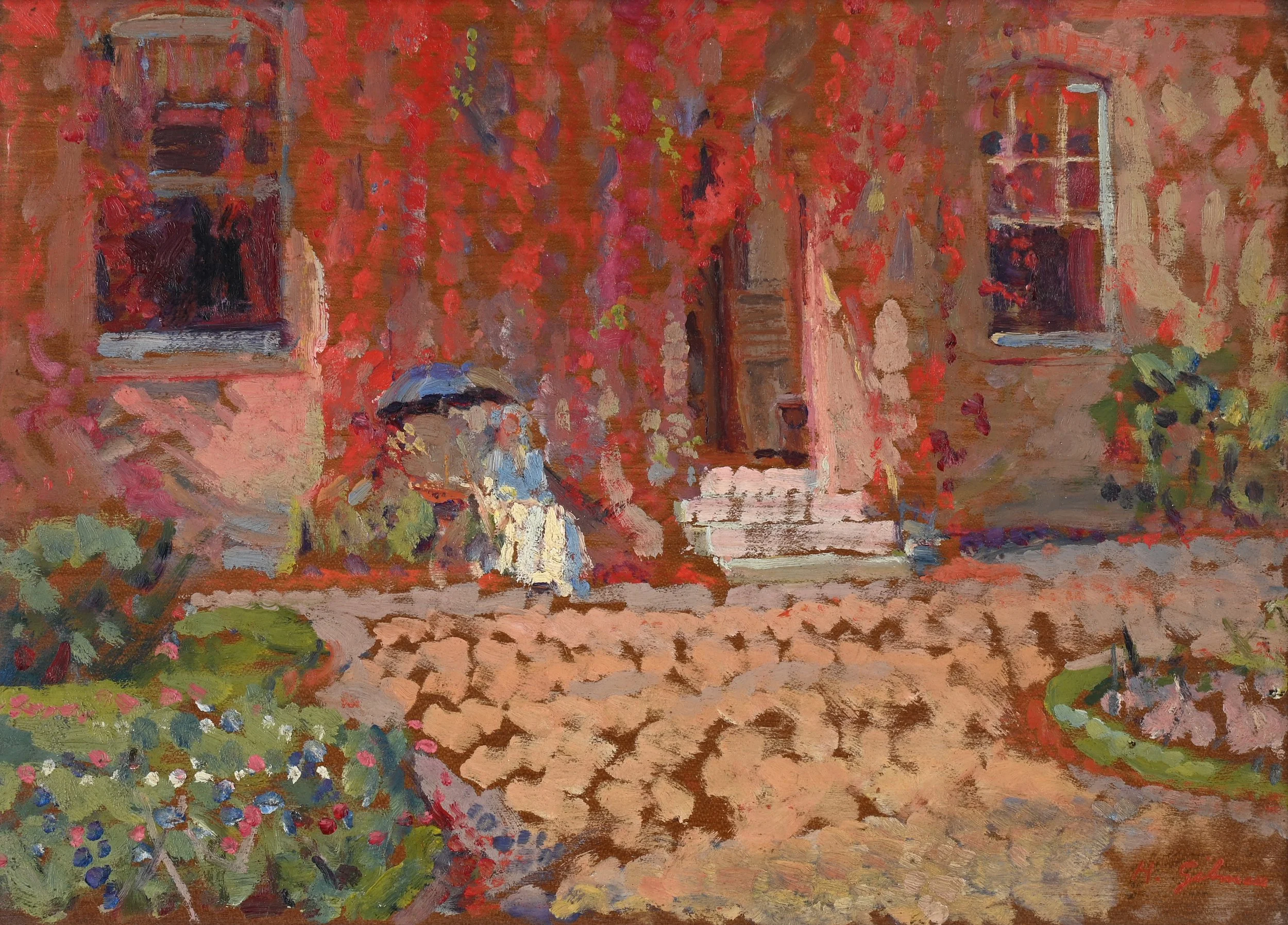
This recently acquired painting will form part of a specially curated display at the fair of work associated with the Camden Town Group, which was formed in 1911 with Walter Sickert, Spencer Gore, Charles Ginner and Robert Bevan as its main participants. Gilman had taken up painting as a boy to stimulate his creative energies after suffering an incapacitating physical injury. He was talented enough to enter The Slade at the same time as a golden generation that included Augustus John, Spencer Gore, Wyndham Lewis, Stanley Spencer, Mark Gertler, Paul Nash and C.R.W. Nevinson. A so-called “Crisis of Brilliance”, as their tutor Henry Tonks put it. A critical influence on Gilman’s development was Roger Fry’s exhibition in London of Manet and the Post Impressionists in 1910, which is around the date of this work, which, with its swiftly deployed brushstrokes and shimmering distribution of light, bears all the hallmarks of the influence of Manet and van Gogh. The subject is his family home at the Rectory in Snargate on Romney Marsh, with his mother sitting outside in the shade of a parasol. Sadly, he died from the Spanish flu pandemic in 1919, aged only forty-three.
It is not known precisely when she acquired this painting, but it was for many years owned by Jemima Pitman, who was the grandniece of John Singer Sargent who died last year. She most likely inherited it from her parents, who had a large collection and died in 1963 and 1971.
Joan Warburton (1920-1996), Still Life with Cedric’s Vase, 1936, oil on canvas, 61 × 70cm. £5,200.
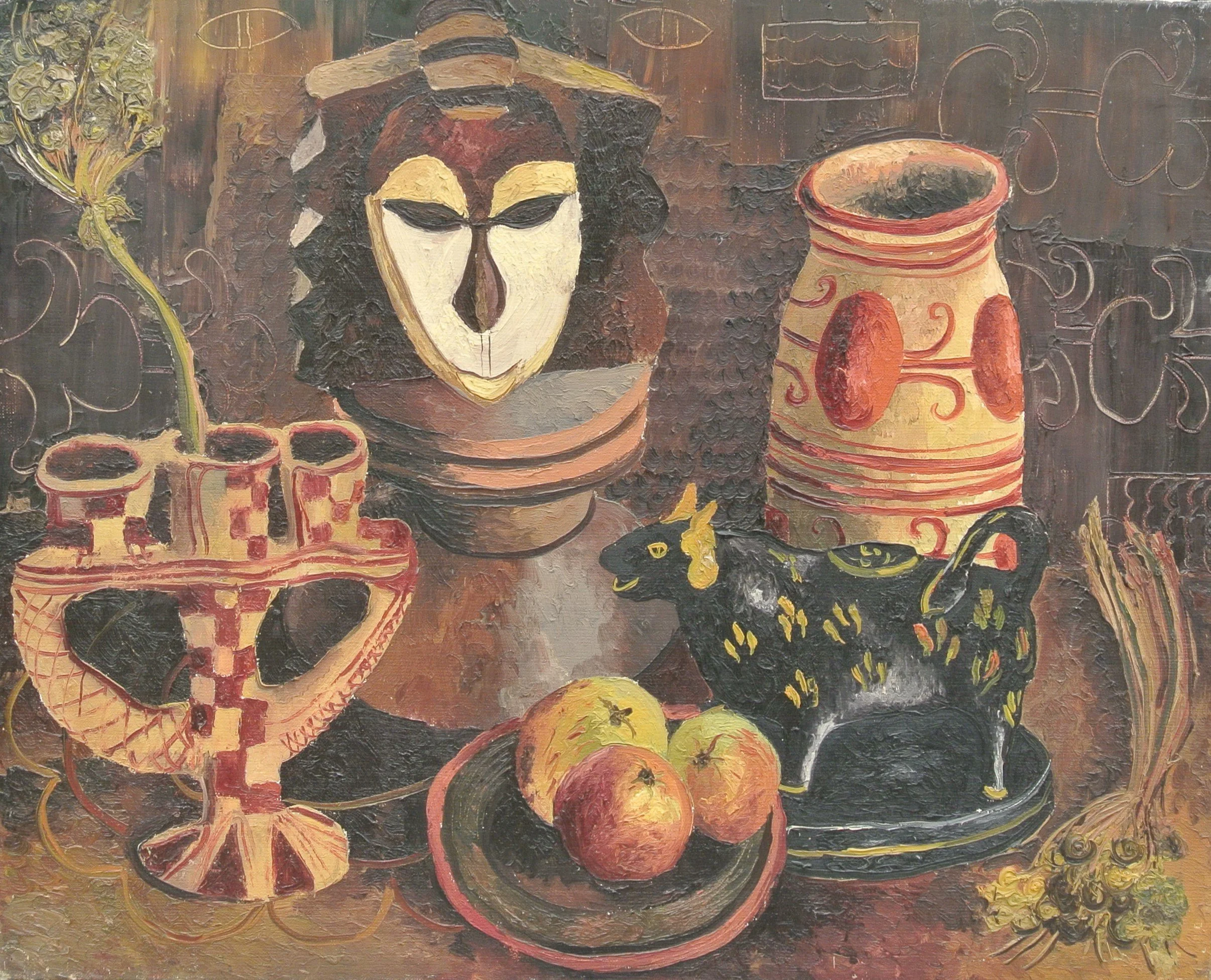
This painting comes from the artist’s estate and was painted during her time as a student at the East Anglian School of Painting and Drawing based at Benton End, Hadleigh, Suffolk. This was where Cedric Morris and Arthur Lett-Haines lived and ran their teaching establishment, celebrated by the current exhibition at the Garden Museum in Lambeth – Benton End: A Paradise of Pollen and Paint, which runs until 20 September 2026. Warburton’s painting seems likely to have been drawn from various objects which Morris collected, housing many in the kitchen, which was the hub of social life at the school.
For the Garden Museum, the curator Dr Patricia Hardy rediscovered the original dining table and kitchen sink, decorated with Portuguese tiles which they found buried in the garden. The house was entered directly by the kitchen – described by Morris’s protege, the horticulturalist, Beth Chatto: “Pale, pink-washed walls rising high above us were hung with dramatic paintings of birds, landscapes, flowers and vegetables whose colours, textures and shapes hit me as though I was seeing them for the first time... while shelves were crammed with coloured glass, vases, jugs, plates with mottoes – a curious hotch-potch, remnants from travels in years past.” Many of the ceramics came from North Africa, which Cedric often visited during the winter months and found their way into his paintings (Still-life with Irises, 1962, exhibited at Gainsborough House Gallery in Revealing Nature, The Art of Cedric Morris and Lett-Haines in 2024, and Red Hot Pokers, 1972, illustrated in Benton End Remembered, 2002). The vase on the right of the Warburton painting, after which the painting is titled, is portrayed in both of these Cedric Morris paintings. The heart-shaped stand bearing a triple flowerpot (lower left) was featured in an earlier still life by Morris, Patisseries and Croissants, circa 1922, in the Tate collection since gifted by Morris’ sister in 1983.
Warburton’s association with Benton End (where Lucian Freud was a contemporary) has helped bring her out of the shadows of neglect, particularly since the Garden Museum exhibition. A new record for one of her paintings was set in July when Chelsea Washing-Day, 1960, sold for £10,240 at Bonhams, following which two further works by her were bought by the Colchester Art Society.
In 2018, the Pinchbeck Charitable Trust bought Benton End, and in 2021 it was gifted to the Garden Museum for the Grade II* listed home and garden to be restored and opened to the public as a museum of art and gardening.
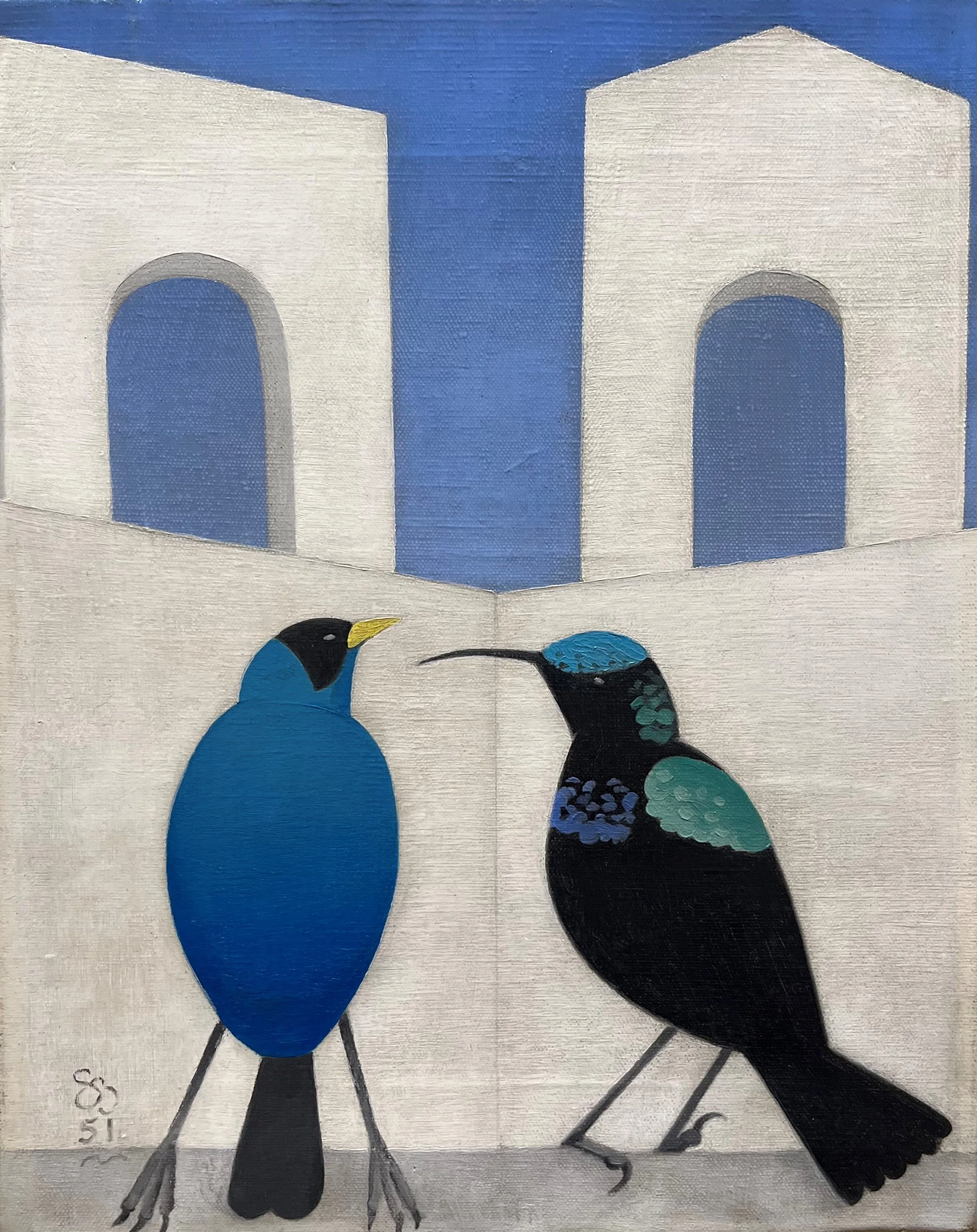
Simon Bussy (1870-1954), African Sunbird and Sugar Bird, 1951, oil on canvas, 27.4 × 21.6cm. £35,000
Although born in France, Simon Bussy lays claim to a certain Britishness by virtue of his marriage in 1903 to Dorothy Strachey, the sister of the historian Lytton Strachey, through whom he associated with the artists and writers of the Bloomsbury Group – Duncan Grant, Roger Fry, Vanessa Bell, Virginia Woolf and Mark Gertler.
As an artist, he is best known for his closely observed and characterful pastels of animals which he developed from around 1912 during visits to London Zoo. “Each [work]”, he wrote, “is an invention, a poetic composition, not only decorative…the animals I paint and the foliage which surrounds them…in my opinion there is no element that has not been the object of patient observation; my numerous studies in pastel, created with the paintings in mind, proves it. My animals, birds and reptiles have nothing trivial; they are actual portraits in which I desire that the resemblance emerges from the incidental with always further clarity, precision and purity.”
The London Zoo opened a special bird viewing area in 1927 called the Blackburn Pavilion or the Bird House. Bussy would have found both birds depicted here in the Bird House, which specialised in exotic birds from Africa. It was also the Bird House which inspired a young David Attenborough to go on expeditions to West Africa shortly after this picture was painted to bring more nectar-feeding birds back to England for study. Around this time, Bussy painted Conversation Piece; Two Toucans (1926-30), with a similar backdrop to the present painting. Originally owned by the historian John Strachey, Conversation Piece was sold at Sotheby’s this year for a quadruple estimate of £20,000. Bussy’s auction record appears to be $66,000 in Switzerland in 2021 for a pair of herons, once owned by the poet André Gide, who hung his bedroom full of Bussy pastels.
Trevor Bell (1930-2017), Hulls, St Ives, ink on paper, 1956. £750
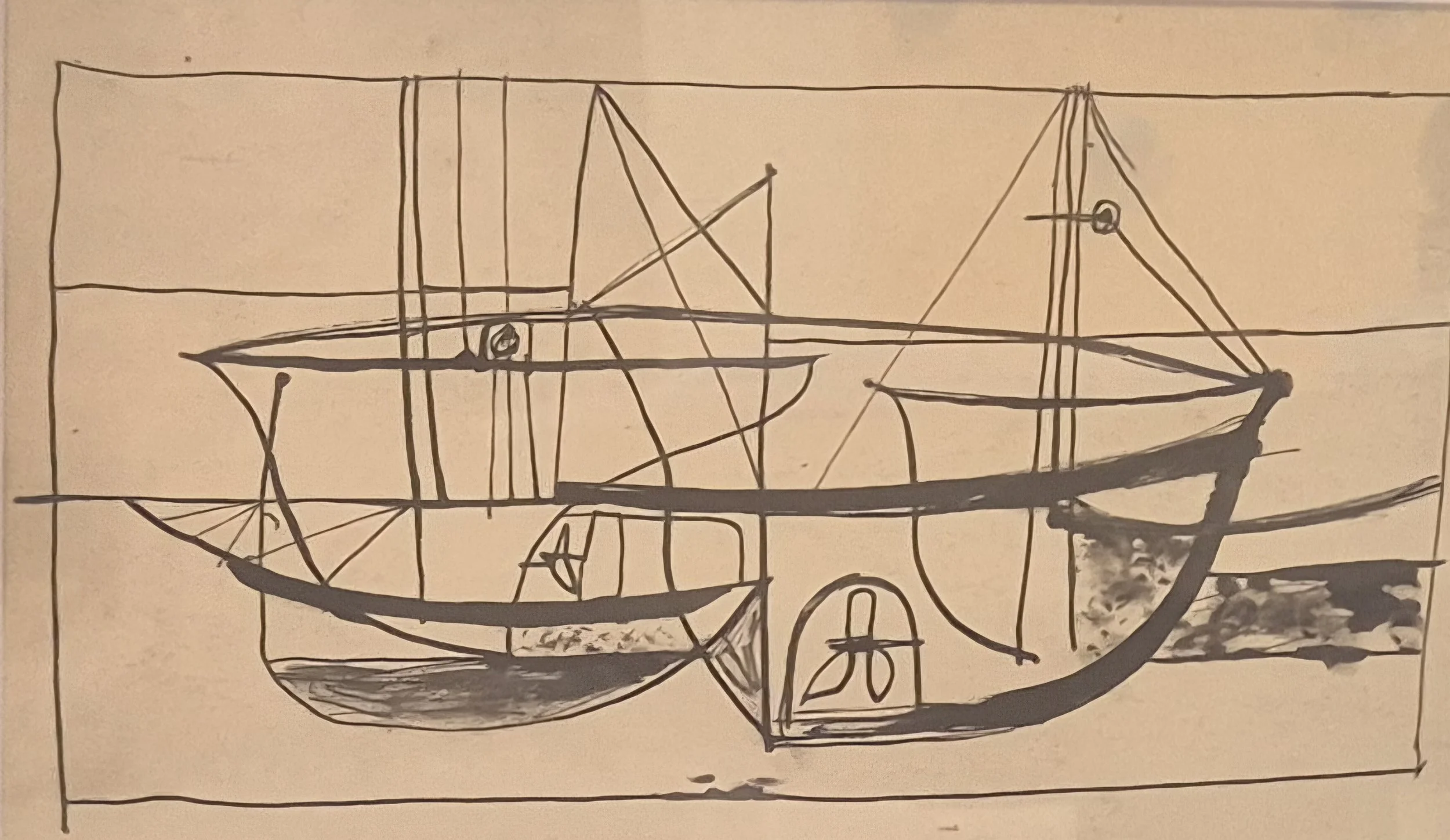
Taken from a sketchbook, this drawing signifies a turning point in the artist’s life when he moved from Leeds, where he attended art college, to St Ives, where he had been encouraged to go by Terry Frost, another Leeds man. St Ives in the fifties, of course, was developing as a lively artistic colony, having been visited by the likes of Ben Nicholson and Barbara Hepworth before World War II and was now being colonised by the next generation of avant-garde painters like Frost, Patrick Heron, Roger Hilton and even Mark Rothko. Enthused with the idea, Bell sold his domestic possessions and drove south on a motorbike with his young wife to see what life could offer. Renting cottages, he began painting ‘ropes and boats’ images, such as Hulls, St Ives, in which the fishing boats provide a structure of entwining shapes that were to prove a stepping-off point for abstraction. His first solo exhibition was staged at Waddington Galleries in London in 1958 and was a sellout.
Since his death, several galleries have seen his estate as an opportunity to promote this somewhat neglected artist. The latest is at British Art Fair where North London’s Fine Art Consultancy present a mini retrospective of Bell’s work starting with his time at art school in the late forties, through to the more lyrical abstract work of the fifties to the larger, shaped, and more colourful canvases from the 1960s to the 1990s. These were inspired by journeys to Florida and the Himalayas, which are priced at up to £14,000. Top prices at auction are around £17,000 and £18,000 – so still a long way for Bell to catch up with his peers.
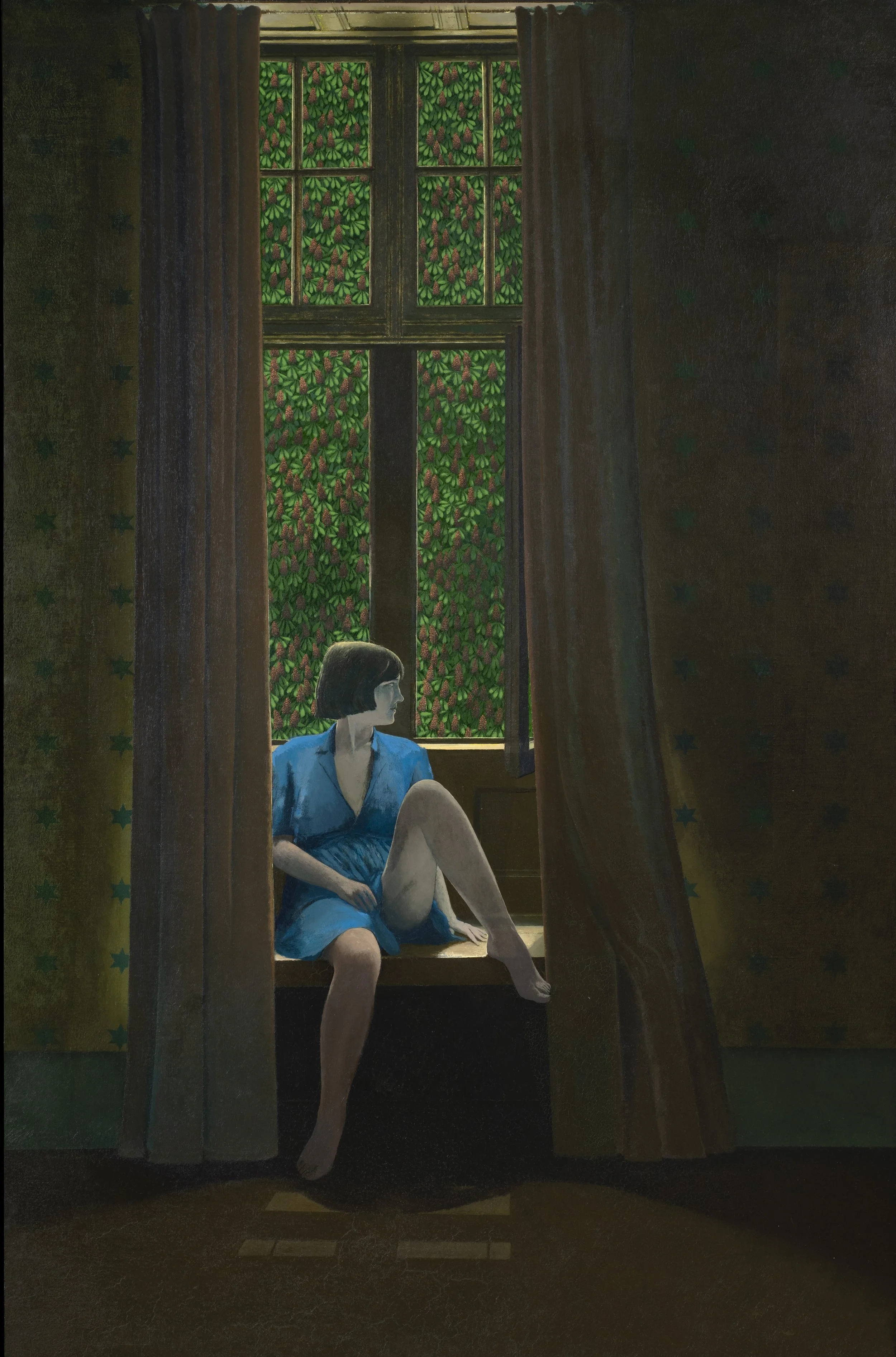
David Inshaw (b.1943), Veronica, Old Guest Room, Trinity College, Cambridge 1976-78. £38,000
“This painting was always a favourite of David's, which is why it was given a full page in my monograph on him (published in 2015 and long sold out)”, writes Andrew Lambirth. “I think the model was Leslie Waddington's secretary at the time, but I can't really check that with David as his memory has gone.”
Inshaw was represented by Waddington from 1975 and moved to Theo Waddington in 1995, then showed with a variety of galleries including Agnew’s, The Fine Art Society and latterly the Redfern Gallery. He is perhaps best known as a member of the Brotherhood of Ruralists alongside Peter Blake and for his moody and psychologically dramatic figurative painting, such as The Badminton Game, which made his name when it was bought by Tate from Waddington in 1980. This painting was also sold by Waddington, but to a collector in America who kept it until this year
Inspired by his admiration for Stanley Spencer and Balthus, Inshaw, in the mid-1970s, was working on interior figure compositions, such as The Letter (1977). In 1975, he was installed at Trinity College, Cambridge, having been awarded a two-year fellowship in Creative Art. This painting is based on a photograph he took at the College in 1976, says Lambirth. It started out as a much more complicated and ambitious composition which in the end didn't work and was cut down to make the painting presented here.
At the time, Inshaw described the genesis of the image, beginning with his first night at Cambridge. “The first night I spent was in the old guest room. This is a wonderful room, the walls are very dark and there's one window in the bedroom with a view out into a courtyard. The only thing you can see looking through the window is a chestnut tree. At the time I went there it was in flower. This was a wonderful experience and I thought it was possibly the germ of a painting. I chose the woman sitting in the window seat because I liked her Louise Brooks haircut - the shape of her hair when she turned sideways. For years - I don't know where it comes from - I've always liked blue and white spotted dresses. I haven't put the spots on yet, they're to come.”
Inshaw never did put the white spots on, and the dress remained a plain but poignant blue.