September 2026
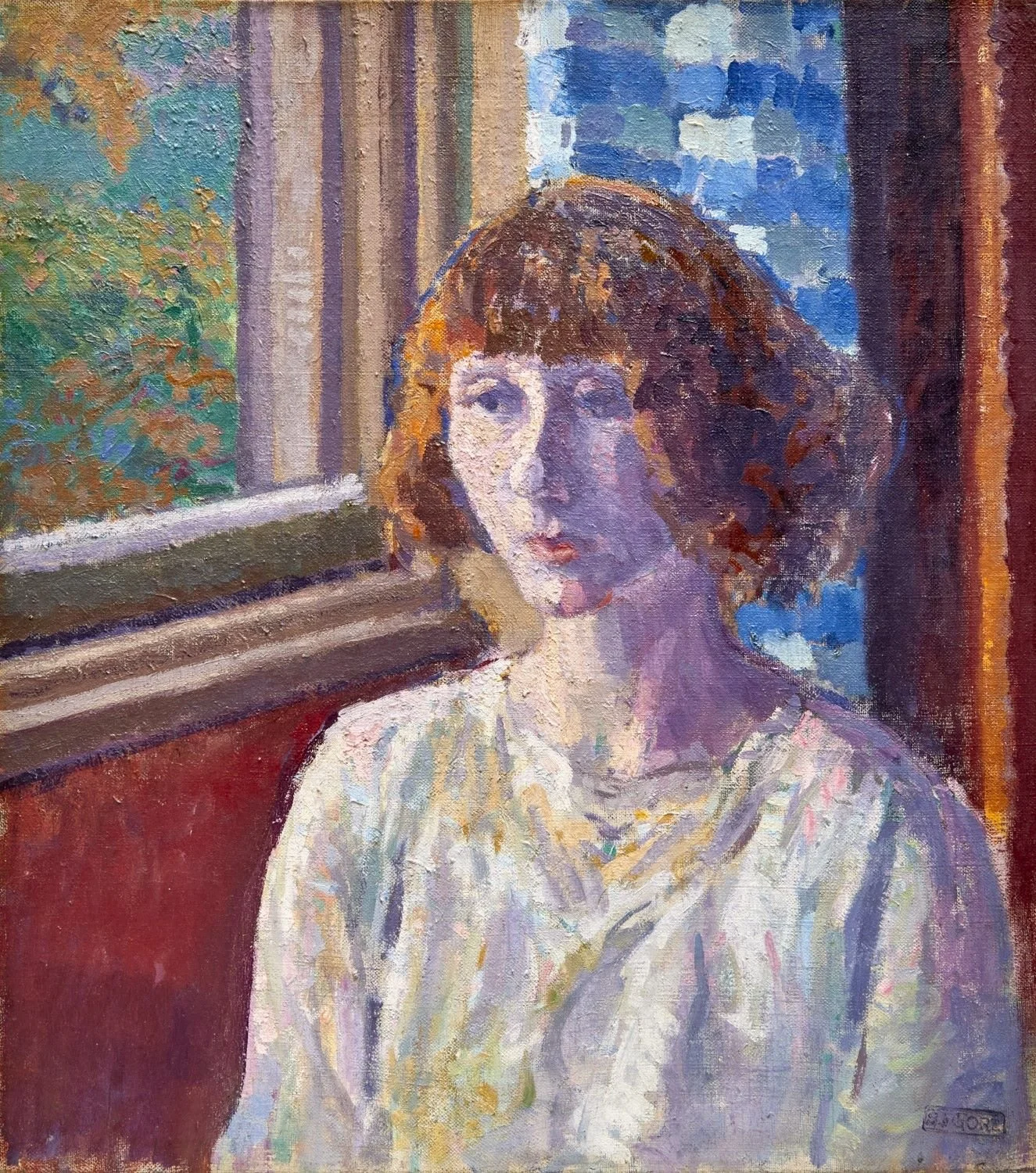
Spencer Frederick Gore (1878–1914), The Artist's Wife, Mornington Crescent, 1911. £48,000
Signed with the artist's studio stamp. Inscribed on label (to reverse of stretcher) in Harold Gilman's hand: Portrait of Mrs S.F. Gore painted by S.F. Gore in 1911 at 31 Mornington Crescent.
Gore is one of the most sought-after of the Camden Town Group of painters, with an auction record of £149,000. But his work is rare, having completed around only 150 paintings in a short lifespan cut short by pneumonia in 1914. Only seventeen paintings have been recorded by Artnet as sold at auction in the last ten years. The present work is not among them.
The sitter is Gore's wife Mollie Kerr, a dancer from Edinburgh sporting a fashionable ‘bob’ haircut. Kerr became the artist's primary sitter in portraits from 1911, when the two met, until his untimely death in 1914. The year 1911 was a key year in Gore's artistic career, coinciding with the foundation of the Camden Town Group of which he was the first president. The remarkable and vibrant use of colour in this painting bears witness to the group's response to the Impressionist and Post-Impressionist artists from Continental Europe. Such work is markedly more avant-garde than much British art from the tail end of the Edwardian period. Gore's painting of Kerr, The Artist's Wife, painted two years later in 1913, was presented to the Tate by the artist's son in 1983. In the Tate’s catalogue, it is stated that the artist made at least four paintings of his wife in 1911, one each in the museums of Leeds, Birmingham and the Te Papa Tongarewa Museum of New Zealand in Wellington, and another in a private collection. This one, which adds to the list, was until recently in the collection of Herbert and Anne Lucas, who collected Camden Town Group paintings in depth. They acquired this work from the Hirschl & Adler gallery in New York in 1988, who described it as "perhaps the most intimate of the series.”
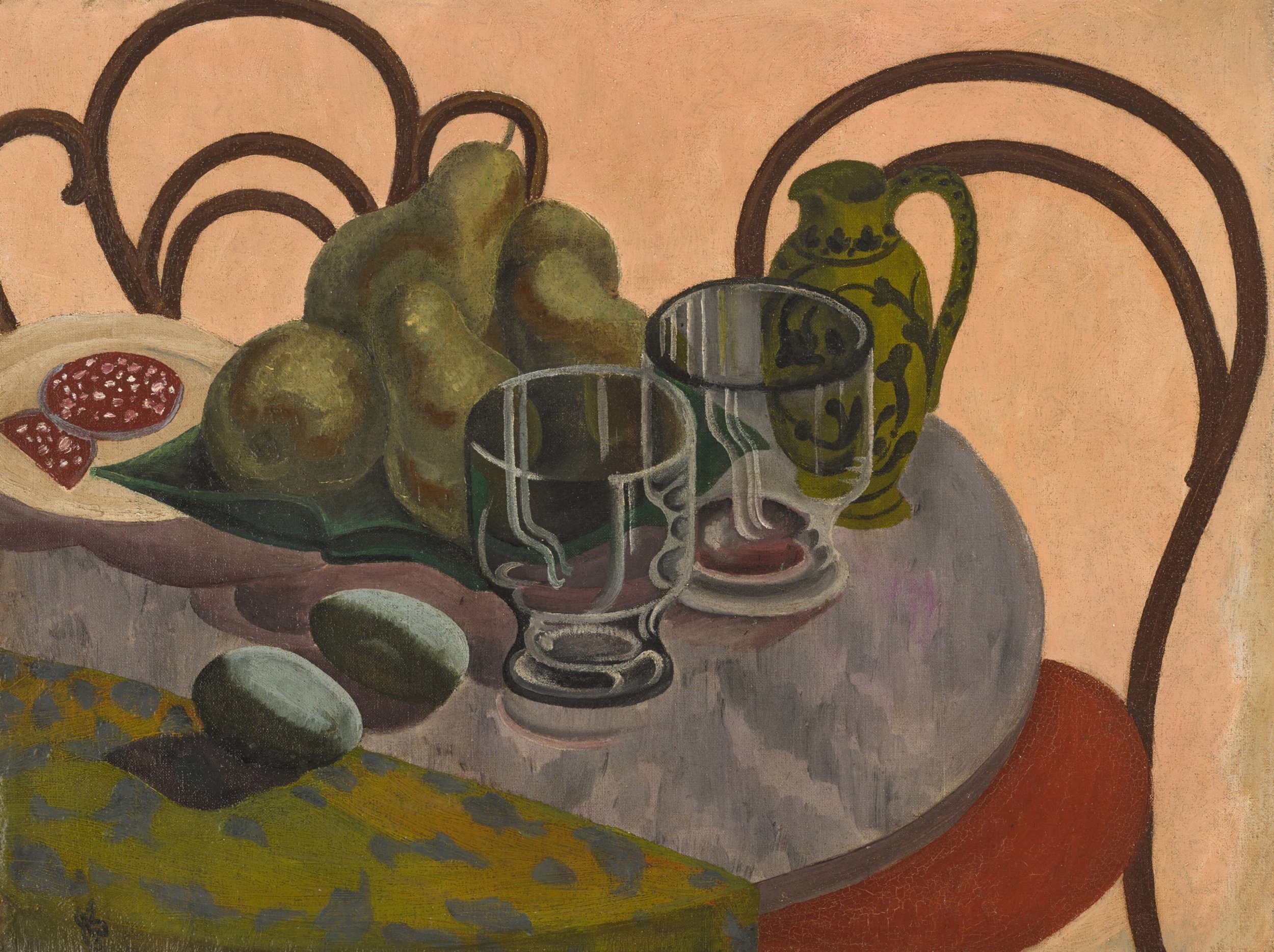
John Banting (1902–1972), Still Life with Pear and Glass, c. 1927. Price in five figures
The centenary of the birth of Surrealism has witnessed a snowballing of demand and prices for surrealist artists from Magritte downwards but has yet to pick up on John Banting. Putting this to rights is dealer John Swarbrooke, who will give a taste of his forthcoming gallery exhibition for Banting at British Art Fair with this early work, which precedes his full-scale embrace of Surrealism in the 1930s when he contributed to the International Surrealist Exhibition in 1936. This painting belongs to a period of productivity and discovery for Banting. Three years after quitting his job as a bank clerk in 1922, he acquired a studio in Fitzroy Street near Duncan Grant. He soon became embroiled in the Bloomsbury Group and the ‘Bright Young People’, notably Eddy Sackville-West with whom he had a brief relationship, and made designs for Leonard and Virginia Woolf’s Hogarth Press and ballets at Sadler’s Wells.
This painting demonstrates all of the talent for which he was being celebrated: the expert handling of muted green, red, and yellow, the skilful execution of the distorting transparency of glass and the depiction of interlocking lines of Bentwood chairs, table circumference and jug handle. But also hints at what is to come. Conspicuously unpeopled, the table setting features two blue-grey eggs which have the hallucinatory hardness of de Chirico. The two empty glasses, far larger than the jug, introduce a subtly disturbed proportion.
Swarbrooke’s exhibition (from 6-18 October) will be the first for Banting in nearly forty years.
Lynn Chadwick (1914–2003), Secondary Maquette for Teddy Boy and Girl, 1956. £216,000 inc. VAT
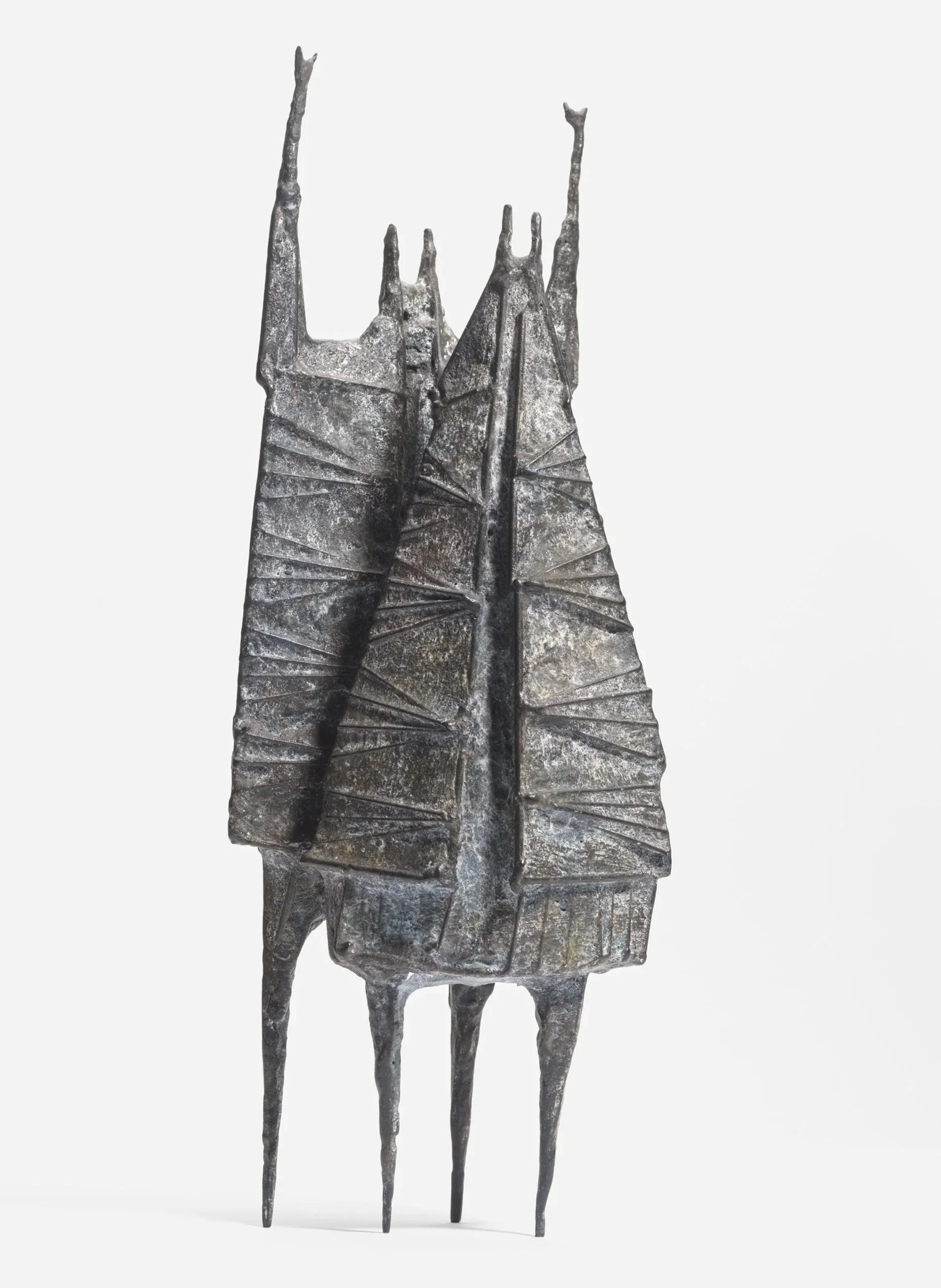
Following in the wake of the impressive Lynn Chadwick show currently on view at Houghton Hall (until 4th October), Pangolin Gallery, London, which curated that show, is presenting a large display of small sculptures, prints and drawings by Chadwick at the fair with prices ranging from £2,500 for a 1974 lithograph to £216,000 (both inclusive of VAT) for a 15 ⅜ inches bronze, Secondary Maquette for Teddy Boy and Girl, 1956.
The bronze is one of Chadwick’s most popular subjects, marking a shift for the artist from post-war politics to more playful social commentary. “Chadwick is sensitive to the atmosphere of celebration, responsive to jazz and jive and rock and roll,” wrote the art critic Robert Melville, “and in Teddy Boy and Girl he has raised a monument to semi-delinquent youth in formal terms reminiscent of English ecclesiastical architecture.”
A larger scale, 6 ½ foot version of this subject sold for £909,000 in 2018. Of related interest at the fair will be a 1955 ink and wash drawing for the sculpture which was shown at the Venice Biennale in 1956 (£12,000) with exhibition labels on the reverse, and a Standing Couple bronze from 1980 which has never appeared on the secondary market before (£180,000).
Muriel Jackson (1901–1977), The Fair on the Heath c.1958. Price on application.
Presented by Florence Evans Fine Art
Florence Evans will be bringing half a dozen stunning tempera works by little-known Muriel Jackson which come from the artist’s estate. This painting is the most significant in size and subject, showing, as it does, "The Fair on the Heath" (as in Hampstead Heath), and was exhibited at the New English Art Club in their winter edition, 1958 (no.169).
Muriel Jackson lived in Hampstead all her life and was fascinated by her locale, including the traveller community. In the background of this painting, you can see the traditional caravan of the Buckland family, as well as the local Italian ice cream vendor in the foreground.
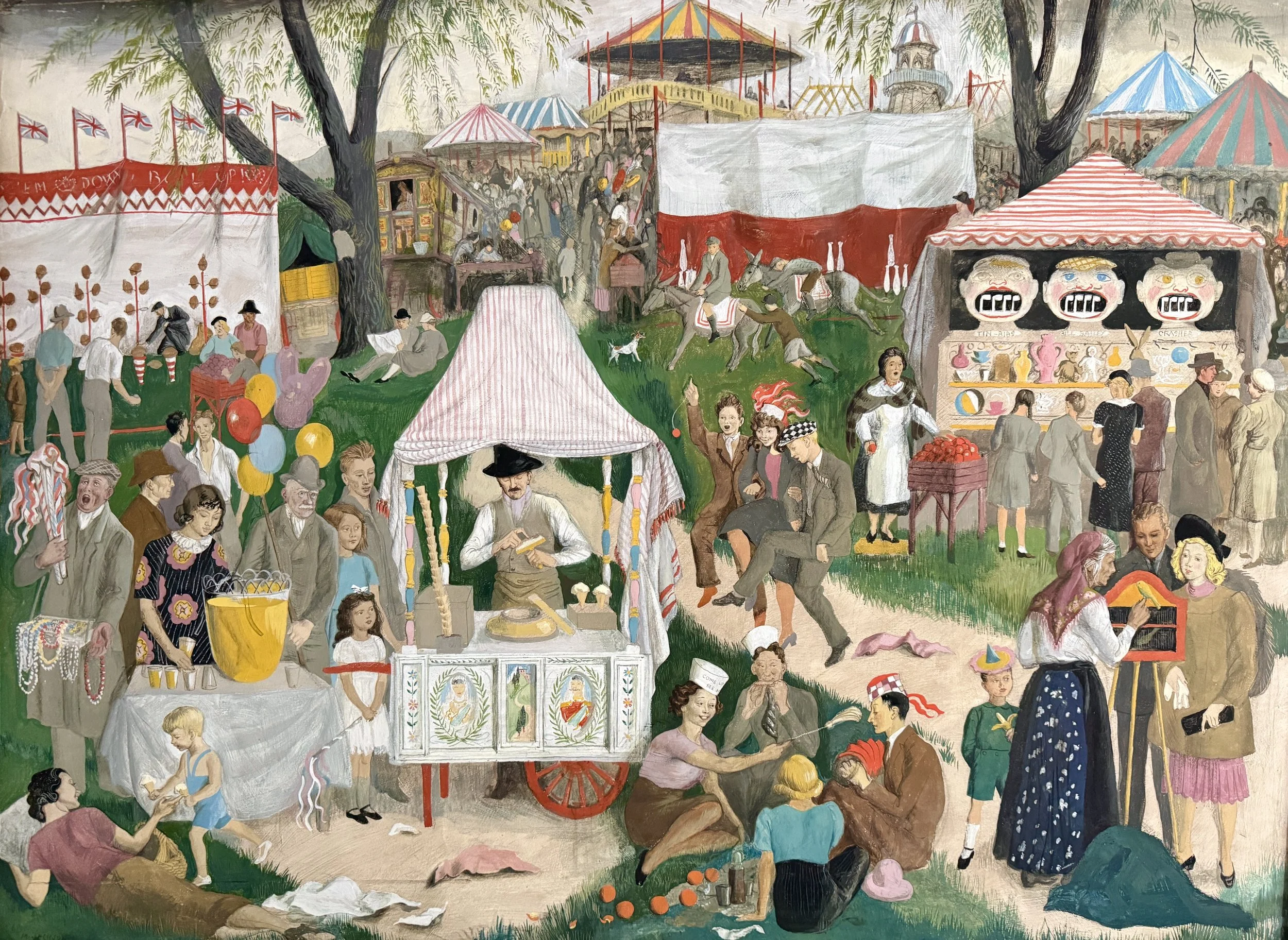
It was at the Heath Fairs that Jackson originally met and befriended Leonard and Ivy Buckland, of Romani descent, who had commissioned their ornate caravan from Dunton and Sons on the occasion of their marriage at the turn of the century. In 1938, when the Bucklands retired from travelling, they sold the caravan to Jackson, who kept it in her garden until she presented it to London County Council in 1948, who placed it on the heath by Kenwood House “its natural setting”. She petitioned for the caravan to be exhibited in the Festival of Britain, and came near to successfully convincing the LCC, had it not been in dire need of repair. Today, the Buckland caravan can still be seen on display in the Kenwood Coach House at Kenwood House, Hampstead Heath.
Muriel trained at the Central School of Arts and Crafts, specialising in mural painting and developing her life-long fascination for tempera, as well as wood engraving. As a student, she was committed to women’s rights and illustrated the front cover of 'The Labour Woman' in October 1924. She was a prize-winner selected for the final competition in painting for the British School in Rome in 1925, the year after Barbara Hepworth, among others.
Jackson came from an artistic family – her father was the architect Arthur Blomfield Jackson, who worked on iconic venues including the Savoy Theatre, and her sister Susannah was the costume designer for the Old Vic theatre. Together they designed the national banner for the Women's Co-operative Guild in 1933.
The News Bulletin for the members of the Society of Wood Engravers in 1941 recorded that Muriel "took a warden's course when war broke out as a voluntary fire watcher. More recently she frescoed the walls of the local communal kitchen [on Flask Walk], with life-sized figures."

David Whitaker (1938–2007), Watershed no 3, 1969. £24,500.
Presented by Rebecca Hossack Art Gallery
One of the joys of this fair is the number of artists who emerge from obscurity. In her first appearance at this fair for several years, Rebecca Hossack does just that with David Whitaker. Following a classical training at the Royal Academy Schools, Whitaker became disillusioned with his job as a designer and became a milkman instead. As an artist, though, he was drawn to Op art, a movement that was then exploring the optical effects of geometric abstraction. Amongst his influences were Byzantine painting, Leonardo, Goethe, Ruskin, Cézanne and the American abstract painter Kenneth Noland. His technique was as precise as a mathematical diagram, stencilling each layer between the strips of tape. Whitaker pursued this fascination with incredible inventiveness for five decades. Through precise geometry and radiant colour, his works, of which this is an example, transform rigorous structure into a meditation on rhythm, light, and harmony.
In his Guardian obituary, he is quoted as asking himself: “Where do my themes come from?” “Waterfalls”, he replied, “Shafts of light in cathedrals and forests; memories of Egypt; coastlines; the wind in the trees; rainbows; sunrises and sunsets; cloud formations; America."
Whitaker's unique approach to this form of abstraction won him the admiration of many. In 1970, he was among the first British artists to have a solo exhibition at the newly founded Serpentine Gallery in London, and in 1973 he received the Mark Rothko Memorial Award on the recommendation of Bridget Riley. He was a regular exhibitor at the Royal Academy and the Royal Watercolour Society (of which he was a fellow).
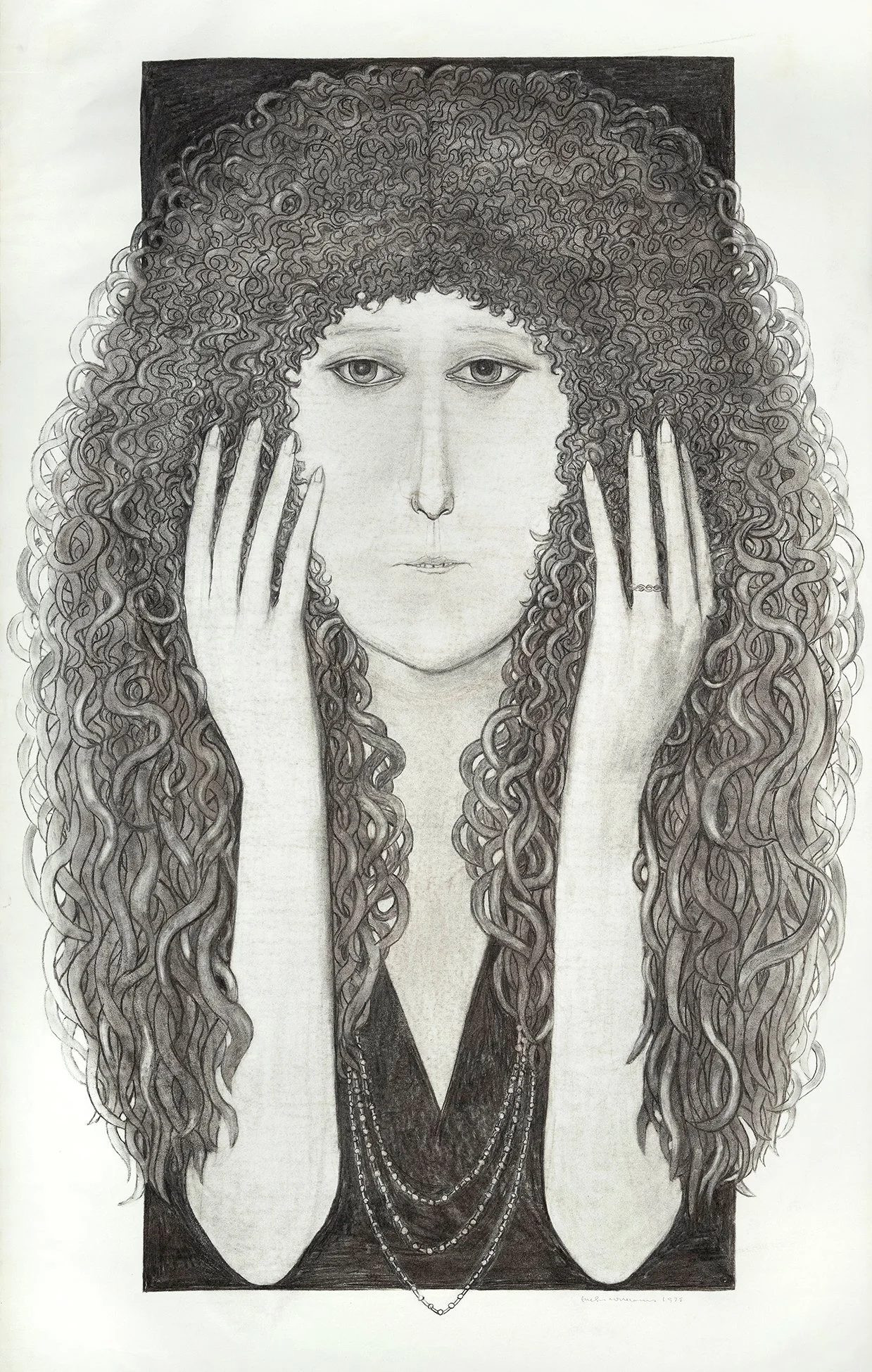
Evelyn Williams (1929–2012), Someone’s Sister. Charcoal, 1975. £2,200
Presented by Abbott and Holder
Abbott and Holder have been busy plundering estates and trusts to provide in-depth displays of works by four artists at British Art Fair, which also serve as previews to gallery exhibitions for those artists, all modestly priced and deserving of greater notoriety.
From their estates comes work by Jean Jones (1927–2012) who studied art at St. Martin’s School of Arts, then English at Oxford, and then art again, inspired by her reading about van Gogh, at the Ruskin School of Art; Alfred Janes (1911–1999), a member of The Kardomah Gang in Swansea that included Dylan Thomas and Vernon Watkins, who will have a show at the Glynn Vivian Art Gallery in October; Hans Tisdall (1910–1997), a multi-talented book jacket and tapestry designer who became a successful mural painter and lecturer at St Martin’s, whose painting from the 1930s to the 1960s will be shown by the gallery next month; and Evelyn Williams (1929–2012) a visionary feminist artist who sold her house in Chiswick to set up a Trust to support the teaching of drawing in art schools. That Trust has given A&H several eye-catching drawings to sell at the fair, including this striking, psychologically penetrating portrait of a woman with cascading locks of hair, drawn just three years after her memorable retrospective exhibition at the Whitechapel Gallery. Little of her work has been seen since her exhibition at Manchester Art Gallery in 1996.